
Views: 0 Author: Site Editor Publish Time: 2026-05-12 Origin: Site


Choosing the wrong framing nail is more than a minor inconvenience. It causes code compliance failures, structural weak points, and tool-jamming delays. These issues inevitably inflate labor costs on the job site. Evaluating framing fasteners requires looking beyond just length. You must weigh tool compatibility, such as collation angles, against structural code requirements for gauge and head type. You also need to consider environmental conditions dictating specific coatings. This guide provides an evidence-based framework for selecting the exact size, type, and collation for your next project. We will take a specific look at the reliability of Plastic Sheet Collated Framing Nails to ensure maximum shear resistance. You will learn how to match fasteners to your tasks, avoid common compliance traps, and easily pass your next framing inspection.
The Sizing Standard: 16d (3.5-inch) sinker nails are the industry standard for 2x4 framing, while 8d (2.5-inch) nails are ideal for sheathing and attachments.
The Penetration Rule: A framing nail must penetrate the underlying base material by at least 1.5 times the thickness of the top material being fastened.
Collation Durability: Plastic sheet collated framing nails offer superior weather resistance on job sites compared to paper tape, preventing inventory waste from moisture damage.
Code Reality: Full round heads are often required by local codes to prevent "overdriving," though extensive testing shows they do not inherently offer more pull-out strength than clipped heads.
You cannot guess when it comes to structural rigidity. Professional framing relies on strict mathematical standards to guarantee structural safety. The most critical benchmark you must follow is the 1.5x penetration rule.
A framing nail must pierce the underlying base substrate by a depth equal to at least 1.5 times the thickness of the top material. We use this mathematical standard to ensure adequate holding power and prevent shear failures.
Consider fastening a standard 2x4 board. A nominal 2x4 measures exactly 1.5 inches thick. To secure it safely, your nail must penetrate the base material by 2.25 inches (1.5 multiplied by 1.5). Add the initial 1.5-inch thickness of your top board. You now need a total length of 3.75 inches. Because a 3.75-inch nail is uncommon, the 3.5-inch 16d nail serves as the closest, safest practical match for standard framing.
The "penny size" system, denoted by the letter "d", remains the industry standard for categorizing nail lengths. Understanding this translation matrix ensures you pick the right fastener for the right job.
Penny Size (d) | Length in Inches | Primary Application |
|---|---|---|
16d | 3.5" | The universal choice for primary 2x4 and 2x6 structural framing. Best for connecting structural lumber. |
10d | 3.0" | Recommended for toenailing (angled driving). It reduces the risk of splitting the wood at corners. |
8d | 2.5" | Optimal for sheathing, subflooring, and non-load-bearing attachments. Prevents blow-through in thin materials. |
Length is only half the equation. You must also select the correct gauge, which measures the diameter of the nail shank. The gauge dictates the sheer strength of the connection. Thicker nails resist snapping under lateral pressure but carry a higher risk of splitting dry wood.
Frame your decision between two primary options. Standard interior framing typically uses a 0.131-inch gauge fastener. It drives easily and handles basic non-load-bearing loads well. However, if you are building heavy structural elements or shear walls, you must upgrade. Strict inspection standards and modern building codes usually require a 0.148-inch gauge nail. These thicker fasteners provide the superior shear resistance necessary for structural integrity during high-wind events or seismic shifts.
Every element of a nail design serves a specific mechanical purpose. Choosing the right combination of head, shank, and coating determines whether a structure stands firm or fails under stress.
A common myth persists among building inspectors and seasoned contractors. Many believe full round heads inherently provide superior pull-out strength compared to clipped-head nails. This is false. According to rigorous ICC ESR-1539 compliance testing, clipped-head and full round head fasteners offer identical pull-out resistance when driven properly.
However, full round heads do provide one massive advantage: a larger surface area. This wider head actively prevents "overdriving." Overdriving occurs when a powerful pneumatic nailer sinks the fastener too deeply into the wood, crushing the fibers and weakening the joint. Because of this risk, local building codes in hurricane- or earthquake-prone jurisdictions frequently ban clipped-head nails. While clipped heads allow you to load more nails into a magazine, they may trigger an instant failure during your building code inspection.
The shank is the body of the nail. Its texture dictates how much friction it generates against the wood fibers.
Smooth Shanks: These are the most economical option. They drive fast and require less energy from your tool. They work perfectly for standard interior wall framing.
Ring Shanks: These nails feature a series of ridges along the body. As they drive in, wood fibers expand into the grooves, locking the nail in place. You must use ring-shank nails for roof decking, subfloors, and high-wind zones where maximum pull-out resistance is non-negotiable.
Bare steel rusts quickly. You must select the right coating based on environmental exposure to prevent catastrophic rust failure.
Vinyl/Resin Coating: Commonly found on "sinker" nails. The resin melts from the friction of driving, acting as a lubricant. Once it cools, it functions as an adhesive, improving your overall grip.
Electro-Galvanized (EG): This thin layer of zinc offers mild rust protection. It serves well for interior projects or areas protected from direct weather.
Hot-Dipped Galvanized (HDG): You plunge the steel into molten zinc to create a thick, weather-proof barrier. HDG is the non-negotiable standard for exterior exposure and all treated lumber applications.
Pneumatic and cordless nailers require bound strips or coils of nails. We call these bindings "collations." The binding material heavily influences your tool performance, site cleanliness, and inventory waste.
Manufacturers group collation solutions into three primary categories based on the binding material: plastic, paper, and wire. Each material thrives in specific environments and demands different handling procedures on the job site.
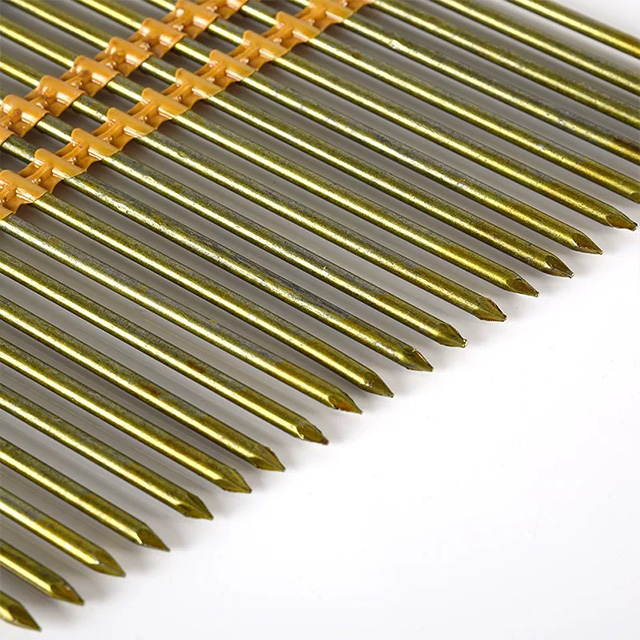
Many contractors consider Plastic Sheet Collated Framing Nails the ultimate choice for tough outdoor jobs. These 21-degree fasteners utilize a rigid plastic strip to hold the shanks together.
Pros: They are extremely durable and fully weather-resistant. High humidity, rain, and mud do not compromise the plastic strip.
Cons/Risks: The firing mechanism shatters the plastic strip. This action can cause sharp plastic debris to fly into the air, requiring strict eye protection (PPE). They also occasionally leave small plastic flags trapped under the nail head.
TCO/ROI Driver: Plastic Sheet Collated Framing Nails drastically reduce wasted material costs. Unlike fragile alternatives, if you drop a box in a puddle or leave it out overnight, the moisture will not ruin the collation. You avoid throwing away expensive inventory and prevent costly gun jams, ensuring a much higher return on your hardware investment.
Paper tape collation binds nails at a steeper angle, usually 30 or 34 degrees.
Pros: They offer the cleanest drive on the market. The paper simply tears and embeds cleanly into the wood. You face no flying debris. Furthermore, the tightly packed angle allows the nail gun magazine to fit more easily into tight corners.
Cons/Risks: Paper is highly susceptible to water. Moisture causes the tape to disintegrate rapidly. If a box gets damp, the nails fall apart. Trying to load degraded paper strips leads to immediate misfires and severe gun jams.
Wire weld collations link fasteners together using thin metal wires, rolled into a circular coil.
Pros: Coil nailers hold up to 300 nails at once. This maximum capacity is unmatched for high-volume jobs like roof decking or fence building.
Cons/Risks: The tools are exceptionally heavy. Additionally, the thin wire welds are prone to saltwater corrosion, making them risky for long-term storage on coastal sites.
Use the following summary chart to compare the three dominant collation methods.
Collation Type | Common Angle | Weather Resistance | Best Use Case |
|---|---|---|---|
Plastic Sheet | 21 Degrees | Excellent (Immune to water) | All-weather framing, heavy structural work. |
Paper Tape | 30/34 Degrees | Poor (Disintegrates when wet) | Indoor framing, tight corners, clean sites. |
Wire Weld Coil | 15 Degrees | Moderate (Wire can rust) | High-volume sheathing, subfloors, siding. |
You cannot buy nails based purely on size and preference. You must account for tool restrictions and the specific structural demands of your task.
Nailers are strictly angle-specific. The magazine design dictates exactly what you can load. A 21-degree framing gun strictly requires 21-degree Plastic Sheet Collated Framing Nails. Attempting to cross-load different angles or collation types guarantees internal tool damage. Always check the stamped specifications on your tool's magazine before ordering bulk fasteners to ensure seamless operation.
Once you verify tool compatibility, align the fastener dimensions with your specific daily task.
Interior / Non-Load Bearing: For building bathroom partitions or closet walls, 3" x 0.131" nails perform brilliantly. They are cost-effective, readily available, and thin enough to prevent wood splitting at the edges.
Shear Walls / Load-Bearing Frames: You must escalate to a 3-1/4" x 0.148" nail. These robust fasteners meet strict shear-force engineering requirements required for structural walls.
Renovation / Old Wood: Remodeling older homes presents unique challenges. Old, dried-out lumber splits easily. Emphasize using thinner gauge fasteners (like an 0.131" or even an 0.120" if code permits) when retrofitting old wood to mitigate severe splitting risks.
Even seasoned contractors make installation errors that compromise structural integrity. Avoiding these common traps saves you from failed inspections and dangerous liability issues down the road.
Never use standard 16d framing nails to secure metal hardware. Detail the danger of using long sinkers for joist hangers, hurricane ties, or tension straps. Standard framing nails are too long and too thin. A 3.5-inch nail easily blows entirely through the side of a standard 2x joist, creating a weak, unstable connection.
Metal hardware requires specific, manufacturer-designated fasteners. These are typically short, thick nails—such as 1.5" x 0.148" standard hardware nails. They resist extreme shear forces without penetrating entirely through the underlying joist.
The direction you drive the fastener matters immensely. Driving nails parallel to the wood grain guarantees structural failure. The wood fibers easily part, offering almost zero holding power. Always drive perpendicular to the grain. Crossing the grain maximizes friction, preventing the shank from slipping backward under stress.
Do not assume your usual fasteners meet local regulations. Advise your procurement and site managers to verify municipal codes regarding clipped-head restrictions and seismic nailing patterns. Do this before you buy 2000-count or 5000-count bulk boxes. A local inspector will halt your project immediately if you use clipped-head nails in a designated seismic or hurricane-prone zone. Double-check the required gauge, length, and coating for every structural joint on the blueprint.
Selecting the correct fastener ensures your framing holds up against time, weather, and rigorous municipal inspections.
Verify local code: Always check your local building codes for head shape restrictions before buying fasteners.
Match the tool: Ensure the magazine angle and collation type (e.g., 21-degree plastic) perfectly match your nail gun specifications.
Apply the rule: Use the 1.5x rule to guarantee your nail length provides adequate penetration for shear resistance.
Select the coating: Base your coating choice purely on environmental exposure. Use HDG for outdoor and treated lumber applications.
As a next-step action, recommend auditing your current pneumatic tool inventory for angle compatibility. Once you know your exact tool constraints, you can confidently purchase bulk framing materials or heavy-duty exterior fasteners without the risk of costly returns or job site jams.
A: Nails are superior for framing due to their high shear resistance—they flex under structural shifts without breaking. Screws have high pull-out resistance but are brittle under lateral (shear) pressure, making them better for non-structural precision work or temporary holds.
A: Mechanically yes, but legally often no. While pull-out strength is identical, many local building codes explicitly forbid clipped heads in structural framing due to the risk of overdriving. Always consult local regulations.
A: The gold standard is a 16d sinker nail (3.5 inches long). If you are toenailing (driving at an angle), drop down to a 10d (3-inch) nail to prevent the 2x4 from splitting.


