
Views: 0 Author: Site Editor Publish Time: 2026-05-08 Origin: Site


While a fastener's appearance might seem basic, the unique, stacked-head design of a duplex nail solves a specific, costly problem in construction. When you look at one, you notice its unusual double head. We formally call them Duplex Head Nails. You might also know them as double-headed, scaffold, or formwork nails. They are specialized fasteners engineered exclusively for temporary structures. William Arthur Collings invented them in 1916. He wanted to replace the damaging practice of leaving common nails partially driven. For contractors and procurement managers, understanding this design isn't just about identifying the nail. It is about reducing labor hours, minimizing job site injuries, and drastically cutting lumber replacement costs. By mastering their application, you can protect expensive materials. Read on to discover how these small components deliver massive return on investment and streamline your temporary builds.
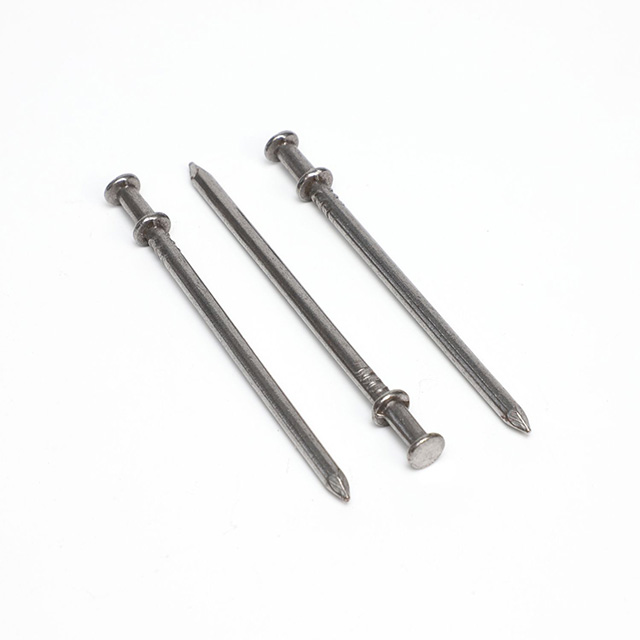
Distinct Visual Design: Characterized by a "stacked" double head separated by a short collar, designed so the bottom head sits flush while the top remains exposed.
TCO & ROI Drivers: The design prevents workers from having to "dig" into expensive lumber to remove fasteners, saving material costs and accelerating teardown times.
Procurement Sizing Rule: The standard industry rule of thumb is a 1:2.5 ratio—nail length should be 2.5 times the thickness of the attached material.
Measurement Standard: To avoid purchasing errors, length is officially measured from the nail point to the underside of the *bottom* head, not the very top.
Compliance: Industrial-grade duplex head nails must meet ASTM F1667 manufacturing specifications.
The defining visual feature of these fasteners is their stacked double head. This is not a manufacturing defect. It is a highly intentional engineering choice. The dual-head system separates into two distinct functional zones.
First, consider the bottom head. It drives completely flush against the wood surface. This creates tight, secure contact. It provides the exact structural holding power and stability you expect from a standard common nail. The flush fit prevents the attached materials from shifting under heavy loads.
Second, observe the exposed top head. It remains protruding above the wood surface. A short collar separates it from the bottom head. This gap is the secret to its utility. It creates a perfect, accessible space. You can easily slip a pry bar or claw hammer under this top head. You never have to guess where to place your tool.
If you examine the body of the nail, you will notice a smooth, uncoated shank. Many permanent structural fasteners use rings, flutes, or adhesive coatings. They do this to maximize grip over decades of use. Temporary structures require a completely different approach.
The smooth shank is an essential design feature. It ensures clean, frictionless extraction. When it is time to dismantle a formwork frame, the nail must release its grip smoothly. A ring-shank design would bind inside the wood fibers. The smooth profile guarantees you can remove the fastener without splintering the surrounding lumber.
Manufacturers forge these nails from heavy-duty low-carbon or high-carbon steel. This material choice provides the shear strength required to hold heavy wet concrete.
You can usually identify them visually by a "Bright" finish. This means they feature uncoated steel. Because crews use them for temporary, short-term projects, they do not need long-term rust prevention. However, exceptions do exist. You can source white electro-galvanized versions. You should choose these when your temporary project faces prolonged exposure to wet weather conditions.
Wood is a major expense on any construction site. Standard flush nails damage this wood during removal. Workers must gouge and splinter the surface to get their hammer claws underneath the buried nail heads. This ruins the material.
The unique double-head design eliminates this surface damage completely. You do not need to dig into the wood. The top head provides a clear pulling point. This allows contractors to reuse expensive concrete formwork and temporary bracing lumber across multiple jobs. Preserving this material drastically lowers the Total Cost of Ownership (TCO) for a project.
Teardown represents a heavy labor expense. Every minute your crew spends struggling to pull stubbornly embedded nails costs money. The exposed top head allows for rapid, continuous extraction.
Workers simply hook their hammers onto the protruding heads and pull. They do not struggle to gain leverage. They do not pause to reposition their tools. This ergonomic advantage directly reduces man-hours during project completion. You can clear a site significantly faster. This accelerates your overall project timeline.
Safety directly impacts your bottom line. Digging out stubborn common nails creates multiple hazards. It often leads to sudden tool slippage. This causes hand injuries, bruised knuckles, and severe worker fatigue. The reliable grip on the top collar of high-quality Duplex Head Nails minimizes these safety risks. The pry bar locks securely into place. This mechanical certainty prevents sudden slips. By reducing site accidents, you lower the risk of workers' compensation claims.
Cost Impact Summary Chart
Performance Metric | Common Nail Teardown | Duplex Nail Teardown |
|---|---|---|
Lumber Preservation | High damage, low reuse rate. | Zero surface gouging, high reuse. |
Labor Efficiency | Slow, requires surface digging. | Rapid, continuous extraction. |
Injury Risk | High tool slippage potential. | Low risk due to secure tool grip. |
You will find these highly specialized fasteners across several major industries. Below are the primary commercial use cases.
Concrete Formwork (The Standard Use Case): They are ideal for the entire concrete pour lifecycle. Crews use them to assemble the wooden forms. They hold the structural integrity perfectly while the concrete is being poured. They maintain this grip during the entire curing phase. Once the concrete cures, the exposed heads allow for rapid, vibration-free stripping of the wooden forms.
Scaffolding and Temporary Bracing: Safety and stability are paramount here. Crews use them to secure temporary structural supports. They anchor wall bracing securely. They hold temporary safety rails firm. Since these structures must eventually be dismantled, the double-head design makes the final teardown swift and safe.
Event and Alternative Architecture (Scalable Flexibility): Their utility extends far beyond traditional construction sites. Their rapid-deployment and high-bite characteristics make them incredibly popular in specialized fields. You will see them heavily utilized in technical theater set building. Festival crews use them for massive temporary structures. For example, they anchor heavy shade cloths at events like Burning Man. They also secure temporary outdoor fencing for crowd control.
Many procurement managers make a critical purchasing error. They measure the nail incorrectly. To purchase the correct size, you must understand the official measurement standard.
The length of Duplex Head Nails is measured strictly from the tip of the point to the bottom of the lower head. You do not include the space between the two heads. You do not include the top head. The primary length specification only accounts for the portion that penetrates the wood. If you measure to the very top, you will order nails that are too short for your structural needs.
Choosing the right gauge and length determines the success of your hold. The industry relies on a straightforward sizing formula.
To calculate the required length, use this simple equation: Material Thickness × 2.5 = Nail Length.
Here are practical examples of this rule in action:
Lumber Thickness | Calculated Length Need | Recommended Penny Size |
|---|---|---|
1 inch | 2.5 inches | 8d (8-penny) |
1.5 inches | 3.75 inches | 10d or 12d |
2 inches | 5.0 inches | 16d (16-penny) |
Do not compromise on quality when purchasing bulk fasteners. You must ensure your vendor specifications explicitly state compliance with ASTM F1667 standards. This standard guarantees structural reliability and ensures the steel possesses the correct shear strength. When sourcing industrial-grade Duplex Head Nails, verifying this compliance prevents catastrophic failures during heavy concrete pours by ensuring consistent wire gauge dimensions and metallurgical integrity.
You should specify these fasteners strictly for temporary applications. If dismantling the structure is a guaranteed future step, this is your best option.
You must prioritize them when the cost of labor and lumber reuse outweighs the fastener cost. Yes, a box of double-headed nails costs slightly more than common nails. However, the savings generated by reduced labor hours and salvaged lumber quickly cover this initial price difference. Always view them as a cost-saving investment for temporary builds.
You must never use them for permanent structural applications.
Do not use them for permanent framing, subflooring, or finished carpentry. The protruding top heads present a significant physical hazard if left in permanent walking or working areas. Furthermore, they will severely interfere with drywall installation or exterior cladding application. The protruding heads prevent flat surfaces from sitting flush.
Best Practice: For permanent holds, always specify standard framing or concrete nails. You should often choose hardened steel varieties with fluted shanks for maximum permanent grip.
Understanding what a duplex nail looks like is fundamentally tied to its commercial purpose. The stacked dual-head system offers robust temporary holding power paired with rapid, non-destructive removal. They protect your expensive lumber and keep your crews safe.
To maximize your site efficiency, take these actionable next steps:
Evaluate your current formwork and scaffolding teardown costs to identify potential labor savings.
Review your supplier's technical spec sheets before finalizing any bulk orders.
Always verify ASTM F1667 compliance to ensure material integrity.
Match your lumber thickness to the 2.5x sizing chart to request a highly accurate procurement quote.
A: They are most commonly available in a "Bright" finish. This means they feature uncoated, untreated steel. Because crews use them for temporary, short-term tasks, long-term rust prevention isn't necessary. However, galvanized options do exist for extended outdoor temporary projects.
A: You measure from the point of the nail strictly to the underside of the bottom head. The top head and the collar between the two heads are excluded from the official length dimension. This ensures you calculate penetration depth accurately.
A: There is no difference at all. They are the exact same fastener. Terms like "scaffold nail" and "formwork nail" are simply industry nicknames based on their most common commercial applications.
A: No. They are engineered exclusively to hold the wooden forms that contain the wet concrete. You should never embed them directly into the concrete itself. Once the concrete is completely cured, you must entirely remove the nails and the wood forms.


