
Views: 0 Author: Site Editor Publish Time: 2026-05-12 Origin: Site


Professional framing and construction crews constantly juggle opposing demands. You need to push for maximum fastening speed, but you cannot afford to sacrifice job site safety. Traditional plastic or wire-collated fasteners often create expensive headaches. They leave hazardous debris scattered across floors and frequently cause frustrating magazine jams. Dealing with post-job cleanup and worker injuries cuts directly into your hard-earned profit margins.
That is why many builders are making a strategic switch. Paper Tape Framing Nails act as a premium, clean-site alternative to legacy fastener systems. In this guide, we provide an objective breakdown of when to invest in paper-collated options. You will learn how to navigate strict municipal building codes regarding nail head types. We will also show you how to quickly verify tool compatibility before you procure your next bulk order.
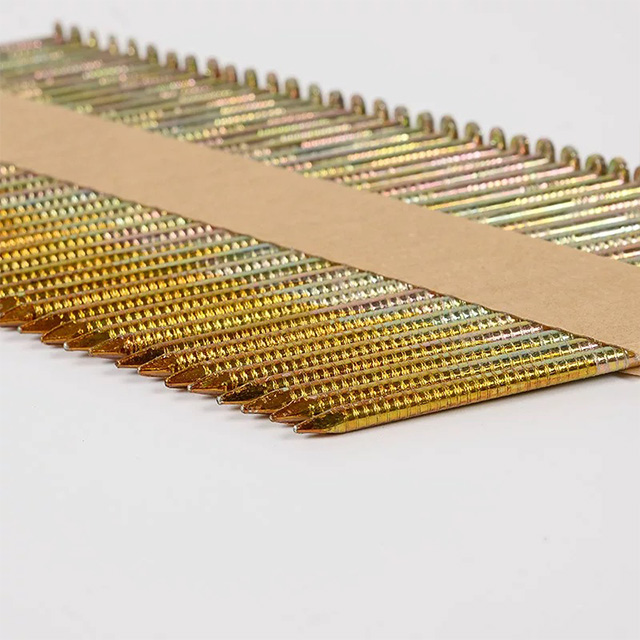
Zero Debris & Enhanced Safety: Paper collation tears cleanly into the wood, eliminating the dangerous, high-speed plastic shrapnel that causes eye and knee injuries.
Tool Compatibility (The 4° Rule): The industry standard for paper tape framing nails spans 30° to 34°. Most strips will fire reliably if they are within 4 degrees of the nailer's specification.
Code Compliance Solutions: Offset round-head paper tape nails bypass the strict building code restrictions often placed on traditional clipped (D-head) nails while maintaining high magazine capacity.
The Environmental Weakness: The primary trade-off is moisture susceptibility; paper strips exposed to heavy rain will disintegrate, turning collated strips into loose hand-drives.
Understanding the core mechanics of paper collation helps you evaluate its true value. Manufacturers use a specialized, biodegradable paper strip. They coat this heavy-duty paper in a rigid adhesive glue. This combination securely holds the fasteners at a precise, uniform angle. When the nail gun firing pin strikes, it drives the fastener forward. The paper tape tears smoothly. It plunges directly into the wood grain alongside the fastener.
Procurement teams often notice a higher upfront price tag on paper-collated fasteners. However, smart project managers calculate the Total Cost of Ownership (TCO). You must weigh the initial purchase price against daily labor savings and risk mitigation.
Eliminated Cleanup Costs: Framing a standard house uses thousands of nails. Plastic collation leaves thousands of sharp plastic shards scattered across the subfloor. Paying a crew member hourly wages to sweep debris destroys your margin. Paper tape leaves zero trace.
Worker Compensation Risk Reduction: Sharp plastic shards create severe slip hazards. Carpenters routinely suffer knee injuries after kneeling on rigid plastic scrap. Removing this debris lowers your overall site liability.
Eye Safety Enhancements: Plastic strips shatter upon impact. Shrapnel routinely flies backward at speeds up to 50 mph. Paper strips eliminate this dangerous facial hazard entirely.
Tool performance directly impacts structural integrity. Paper tape drives seamlessly. Fasteners consistently sit flush against the lumber. You avoid the frustrating problem of "flagging." Flagging occurs when broken pieces of plastic or metal wire get trapped underneath the nail head. Trapped debris prevents a flush drive. It forces carpenters to waste time hammering protruding nails flat by hand.
Building codes dictate exactly which fasteners you can use. Structural holding power relies heavily on the surface area of the nail head. Local inspectors rigorously check framing joints, especially in regions prone to hurricanes or earthquakes. Choosing the wrong head type guarantees a failed inspection.
Clipped head nails feature a distinctive "D" shape. Manufacturers clip off one side of the round head. This design allows nails to sit perfectly flush against each other in the magazine strip. You can pack more fasteners into a single reload.
However, clipped heads carry significant structural risks. Many municipalities strictly ban them. Local building inspectors frequently reject D-head framing nails in hurricane or seismic zones. The reduced surface area provides inadequate pull-through resistance against extreme wind uplift or shear forces.
Engineers developed the offset round head to solve strict code restrictions. The head remains perfectly round. Manufacturers simply position it slightly off-center on the nail shank.
This design serves as a brilliant compliance hack. The offset geometry allows collated strips to be "glued without gaps." You maintain a high magazine capacity, yielding 30 to 40 nails per strip. More importantly, the fastener delivers the full head surface area. This guarantees compliance under strict municipal building codes.
Full round heads offer the absolute maximum pull-through resistance. Historically, achieving a full round head required plastic collation to maintain proper spacing. Newer manufacturing techniques have changed the landscape. Advanced specialized nailers now accept full round heads collated on paper tape. They merge supreme structural holding power and site cleanliness.
Head Type Comparison Chart
Head Type | Magazine Capacity | Code Compliance Risk | Pull-Through Resistance |
|---|---|---|---|
Clipped (D-Head) | High (Tight spacing) | High (Often rejected in seismic zones) | Low to Moderate |
Offset Round Head | High (Glued without gaps) | Low (Passes strict IBC/IRC codes) | High |
Full Round Head | Moderate (Requires wider spacing) | Zero (Universally accepted) | Maximum |
No single fastener type dominates every possible construction scenario. You must match the collation material to your specific environment. Each system carries distinct operational trade-offs.
Best for: Indoor framing, enclosed job sites, and professional crews prioritizing safety and cleanliness.
The Drawback: Paper exhibits extremely low weather resistance. Heavy rain dissolves the binding glue. Once wet, collated strips rapidly disintegrate into loose hand-drives. You must store them in dry, climate-controlled conditions.
Best for: Wet weather framing and budget-conscious procurement. Plastic ignores rain and humidity entirely.
The Drawback: Severe site pollution. As mentioned earlier, plastic shatters. It creates massive sweeping workloads. Shrapnel acts as a major safety hazard, flying into operators' faces upon discharge.
Best for: Extreme, rugged environments. Wire-weld handles heavy abuse. It suits crews requiring exceptionally high magazine capacities.
The Drawback: Wire strips weigh significantly more. They are highly prone to metal flagging. Furthermore, they remain highly specific to 28-degree nailers, limiting cross-compatibility across your tool fleet.
Tool compatibility confuses many novice carpenters. When you buy Paper Tape Framing Nails, you must understand how collation angles actually work. A mismatch causes constant jamming.
The specified degree rating does not indicate how the nail enters the wood. The nail always drives straight at a 90-degree angle to the firing pin. The degree rating refers strictly to the collation angle of the paper strip. Engineers angle the magazine backward. This steep angle provides the necessary clearance to fit the bulky tool into tight corners or between narrow wall studs.
Framing nailers operate on a flexible tolerance system. The industry standard dictates a "4-Degree Golden Rule." Strips falling within a 4-degree variance generally fit into the same gun. For example, you can often run a 30-degree Paper Tape Framing Nails strip inside a 34-degree nailer without issue. The feed mechanism simply pushes the strip upward. However, you should always check exact manufacturer specifications before buying pallets of fasteners.
Tool brands frequently advertise "jam-free" guarantees. Rigid paper tape heavily supports these claims. Brittle plastic bends and snaps inside magazines, causing catastrophic misfires. Paper tape remains structurally rigid. It reduces magazine jams significantly. You just need to ensure your nailer accommodates the specific head type, whether offset or clipped.
Collation material only covers half the equation. You must also select the proper shank type and chemical coating. Applying an indoor fastener to an exterior deck guarantees a costly structural failure.
The texture of the nail shaft determines its holding power. The two primary options serve completely different purposes.
Smooth Shank: These offer the highest drive speed. They plunge into lumber effortlessly. Smooth shanks serve as the industry standard for basic structural framing where shear strength matters most.
Ring Shank: These feature distinct ridges cut into the metal. The wood fibers lock into these rings after the drive. They offer superior pull-out resistance. Building codes mandate ring shanks for subflooring, decking, and siding. They permanently prevent floor squeaking and board popping.
Steel rusts quickly when exposed to oxygen and moisture. Selecting the correct finish protects your build from long-term corrosion.
Bright Finish: These consist of raw, uncoated steel. Use them strictly for indoor, climate-controlled applications where moisture cannot reach them.
Hot-Dipped / Electro-Galvanized: Manufacturers coat these fasteners in a protective zinc layer. They handle exterior exposure and mild weatherability well.
Stainless Steel: This represents the ultimate standard for corrosion defense. You must use stainless steel in coastal environments. It prevents ugly black tannin staining in cedar or redwood applications. Furthermore, ACQ-treated lumber contains highly corrosive copper chemicals. Stainless steel easily withstands ACQ lumber treatments.
Modern crews value mobility. The industry has shifted away from massive, heavy bulk boxes. Procurement teams now favor "Job Packs." These smaller, portable containers allow easier site mobility. They also provide better moisture-controlled storage. Since Paper Tape Framing Nails are sensitive to water, sealing unused fasteners inside a watertight Job Pack at the end of the shift prevents overnight humidity damage and ensures every strip remains project-ready.
Selecting the proper fastening system dictates your daily site efficiency. Paper tape framing nails stand out as the optimal choice for professional crews. They prioritize rapid fastening speed, strict code compliance, and worker safety. By eliminating plastic shrapnel, you drastically reduce both liability and daily cleanup tasks. Keep these concise next steps in mind:
Prioritize offset round heads to seamlessly bypass strict municipal building codes.
Verify your existing framing nailer’s angle rating. Remember the 4-degree rule for 30° to 34° cross-compatibility.
Assess your job site's weather exposure before placing bulk orders. Plan secure, dry storage for paper strips.
Match the shank and finish to the environment. Demand ring shanks for subfloors and stainless steel for ACQ-treated outdoor lumber.
A: No. Prolonged exposure to rain or high humidity dissolves the paper and binding glue. This breakdown causes the strip to fall apart, turning your collated fasteners into loose, inefficient hand-drives.
A: Usually, yes. Thanks to the 4-degree tolerance rule, many 30-degree to 34-degree nails offer reliable cross-compatibility. However, testing a small batch first remains highly recommended before buying bulk pallets.
A: Clipped heads feature a smaller surface area. This physical reduction drastically lowers the nail's holding power against high wind uplift or seismic shear forces. Consequently, they fail strict structural code inspections in high-risk zones.
A: Yes, provided the nails carry the correct coating. You must use Hot-Dipped Galvanized or Stainless Steel to prevent rust. Additionally, you must choose a Ring Shank to prevent the deck boards from popping up over time.


