
Views: 0 Author: Site Editor Publish Time: 2026-06-20 Origin: Site


Modern pneumatic wire nails dominate high-volume framing tasks today, shooting through lumber at lightning speed. However, they frequently fail in specialized applications demanding high pull-out resistance, sheer strength, or historical accuracy. Tasks like heavy masonry attachment, traditional hardwood flooring, and delicate heritage restoration require a completely different approach to fastening.
Incorrectly applying traditional cut fasteners often leads to severe, irreversible substrate damage. You risk splitting rare antique wood, causing deep spalling in masonry walls, and ultimately compromising the entire structural integrity of the assembly. These cascading failures waste materials, cause severe delays, and demand intensive rework from your construction team.
This article provides a rigorous framework for evaluating, specifying, and installing these specialized fasteners. We base these comprehensive guidelines on proven material science and everyday job site realities. You will learn precisely how to select the right fastener category, understand the underlying mechanics, and drive every piece flawlessly.
Cut steel nails rely on wedge mechanics rather than friction, offering superior holding power and shear resistance compared to standard round wire nails.
Proper grain orientation and pre-drilling are non-negotiable implementation steps to prevent catastrophic substrate splitting.
Hardened vs. unhardened categorization dictates the application—never use unhardened cut nails for masonry.
Modifying or cutting steel nails on-site requires specific abrasive tooling due to their hardened metallurgical profile.
Understanding why traditional fasteners hold tighter requires a basic grasp of fastening physics. Standard wire nails rely entirely on friction. As they enter the wood, their round profile pushes fibers aside. Over time, wood expands and contracts naturally, reducing this friction and allowing the round fastener to loosen or back out entirely.
Conversely, square-cut profiles operate on wedge mechanics. Their four-sided, tapered shape actually severs and pushes wood fibers downward upon entry. These crushed fibers act like tiny locking mechanisms, springing back against the rough texture of the metal shank. This wedging action firmly locks the fastener in place, dramatically increasing pull-out resistance over decades of structural movement.
Shear strength defines how much perpendicular force a fastener can endure before snapping. Wire nails bend easily under lateral stress because they lack mass and structural rigidity. The traditional tapered profile features a thick, rectangular cross-section ending in a blunt tip. This massive core provides unparalleled shear resistance.
You need this extreme shear strength when dealing with high-stress horizontal loads. Historic timber framing, wide plank flooring, and heavy barn doors rely on this rigid profile. The thicker shank handles the immense lateral forces generated by shifting structural loads without bending or yielding.
We must acknowledge the practical trade-offs. Using specialized fasteners means abandoning the speed of pneumatic nail guns. You commit to slower, manual installation methods. They also demand a higher upfront material investment compared to bulk wire coils.
They represent a specialized structural solution, not a general-purpose replacement for pneumatic framing tasks. Reserve them for projects where extreme durability, shear strength, or authentic historical aesthetics outweigh the need for rapid installation.
Feature | Standard Wire Nails | Cut Steel Fasteners |
|---|---|---|
Holding Principle | Side friction | Wedge mechanics & downward fiber locking |
Shear Strength | Low to Moderate (Prone to bending) | Extremely High (Rigid cross-section) |
Installation Speed | Fast (Pneumatic compatible) | Slow (Manual driving required) |
Best Application | High-volume framing, temporary structures | Masonry, hardwood flooring, heritage restoration |
Penetrating dense substrates like brick, mortar joints, and concrete blocks demands specialized metallurgy. Hardened masonry fasteners undergo a rigorous heat-treating process. Manufacturers quench and temper the metal to achieve a high-carbon composition. This process hardens the shank enough to fracture aggregate without buckling upon hammer impact.
Environmental compliance is equally critical. Driving raw steel into exterior masonry guarantees future rust. As the metal oxidizes, it expands significantly. This rust expansion causes spalling, cracking the surrounding concrete or brick. Always verify exterior-grade galvanization or specify corrosion-resistant alloys when working outdoors.
Woodworking and restoration projects rely on standard, unhardened variations. You will find these extensively used in antique wide plank flooring, face-nailing applications, and faithful heritage restorations. Because they are malleable, they accommodate the natural movement of wood framing without snapping.
Finish selection depends heavily on aesthetic requirements and moisture exposure. We outline the common finishes below.
Finish Type | Visual Appearance | Moisture Resistance | Ideal Application Scenarios |
|---|---|---|---|
Bright Steel | Shiny, raw metal | Very Low | Interior cabinetry, dry subflooring |
Black Oxide | Matte black, forged look | Low to Moderate | Historical interiors, antique furniture |
Hot-Dipped Galvanized | Rough, dull gray | Very High | Exterior cladding, outdoor decks |
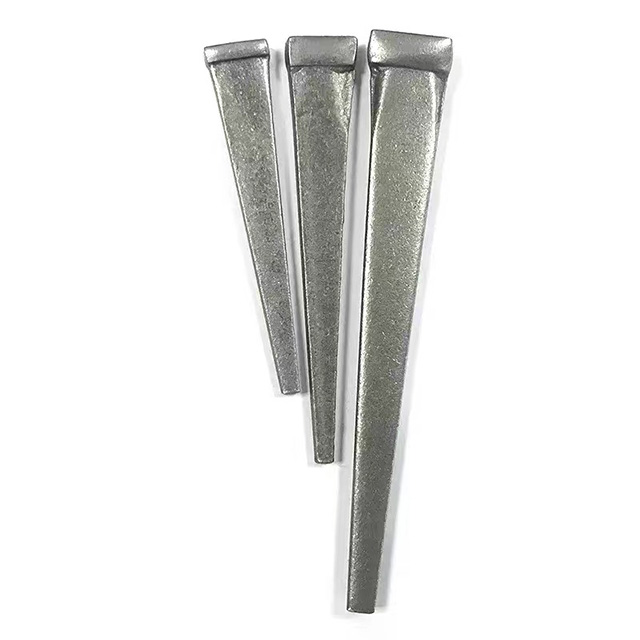
Countless boards split because installers ignore one critical geometric rule. You must always align the wide, blunt side of the shank parallel to the wood grain. The physics here are simple but unforgiving. When driven properly, the narrow edge cleanly severs the wood fibers, allowing the wider body to follow without excessive pressure.
If you align the wide side perpendicularly to the grain, the shank acts exactly like a splitting maul. It forces an enormous wedge directly against the tightest bonds of the wood, resulting in immediate and catastrophic board splitting. Train every crew member on this orientation rule before they lift a hammer.
Even with perfect grain orientation, certain applications demand precise pilot holes. Relying on sheer impact force in brittle substrates guarantees failure. Establish strict pre-drilling protocols across your job site.
Dense Hardwoods: Drill pilot holes when fastening oak, maple, or hickory to prevent surface blowouts.
Board Ends: Always pre-drill within three inches of any board end. End-grain lacks the elasticity to absorb the wedge impact.
Brittle Masonry: Pre-drilling mortar joints or older brickwork prevents structural crumbling.
Your pilot hole must match the narrowest dimension of the nail shank. Do not drill a hole matching the wide taper, or you will completely eliminate the wedge locking mechanics.
Leave modern nail guns and lightweight finish hammers in the truck. Traditional fasteners require significant kinetic energy to drive properly. We recommend selecting heavier framing hammers. A head weight between 20oz and 24oz provides the necessary driving force behind each swing.
The heavier head drives the thicker wedge profile efficiently through dense materials. Lighter tools require excessive swinging, increasing operator fatigue and drastically raising the risk of glancing blows. Glancing blows easily bend unhardened shanks or cause hardened heads to chip.
Site realities rarely match textbook plans perfectly. During complex installations, fasteners frequently exceed the ideal depth, risking over-penetration into underlying plumbing or delicate finishes. Additionally, demolition and restoration phases often require removing or severing existing hardened fasteners seamlessly. When encountering these roadblocks, modifying or Cutting Steel Nails safely becomes a necessary skill for your team.
Not all tools can handle heat-treated metallurgy. Attempting to use improper equipment guarantees tool destruction and creates severe safety hazards from flying shrapnel.
What works: You need high-speed abrasive tools. Angle grinders equipped with aluminum oxide or diamond cut-off wheels work exceptionally well. For tighter spaces, utilize heavy-duty bi-metal reciprocating saw blades specifically engineered for heavy metal severing.
What fails: Standard bolt cutters, diagonal pliers, and manual hack saws will fail immediately. These shearing tools chip, dent, or shatter completely when attempting to bite into heat-treated masonry fasteners.
We advise extreme caution when altering the factory taper of any structural fastener. The tools required for Cutting Steel Nails throw hazardous sparks and require full eye and face protection. Furthermore, trimming the tip fundamentally alters the wedge dynamics.
If you remove too much of the blunt tip, you lose the downward fiber-crushing action. The altered fastener acts like a crude wire nail, pushing fibers aside and increasing the likelihood of splitting. Always prioritize ordering the correct length from the manufacturer over relying on excessive on-site modifications.
Evaluating a manufacturer’s quality control begins with a visual inspection. Examine a bulk sample closely. Look for highly uniform tapers and clean, un-splintered heads. Inconsistent tapers indicate worn manufacturing dies. If the heads show irregular burrs or jagged edges, they will likely sit unevenly upon the wood surface or chip under heavy hammer strikes.
Do not rely on marketing labels when specifying structural attachments. Advise buyers to request comprehensive specification sheets from the vendor. You need verified documentation detailing the carbon content and the exact heat-treatment processes utilized. This step is absolutely vital when purchasing hardened masonry variations in bulk. Without guaranteed tempering, the fasteners will shatter against concrete blocks, halting your project immediately.
Implement a clear decision framework for procurement. Premium fasteners command a significantly higher initial price point than standard alternatives. However, you must evaluate this against the cost-to-failure ratio.
The higher cost directly offsets the devastating impact of structural rework. You eliminate the labor hours spent replacing split luxury hardwood flooring. You prevent dangerous failures in masonry attachments. Investing in superior metallurgy ultimately protects your project timeline and preserves structural integrity.
Successfully integrating traditional cut fasteners requires discipline and a strong understanding of material science. You must select your categories strictly based on the substrate, matching hardened variants to masonry and unhardened options to woodwork. Enforce rigorous site protocols daily, ensuring every crew member understands grain orientation and proper pre-drilling techniques.
Furthermore, sourcing components from transparent manufacturers guarantees the metallurgical performance needed for demanding applications. We leave you with one final piece of practical advice: always test your driving techniques on scrap materials matching your actual project substrate. Confirming your pilot hole sizes and hammer swings before committing to high-volume installation prevents costly mistakes on the final finish.
A: No. You must use heat-treated, hardened masonry nails for concrete or brick. Unhardened fasteners will bend, buckle, or shatter upon impact. Using the correct hardened variant prevents dangerous fastener failure and ensures a secure, lasting attachment in tough masonry substrates.
A: Always use abrasive cutting methods like an angle grinder equipped with a metal-cutting disc. Avoid shearing tools like bolt cutters or diagonal pliers. Shearing actions risk shattering brittle hardened steel or tearing out chunks of the surrounding antique wood you want to preserve.
A: While you can use any standard hammer, a heavier framing hammer is strongly recommended. A head weighing between 20oz and 24oz provides the necessary driving force. This extra mass drives the thicker wedge profile efficiently, reducing arm fatigue and preventing glancing blows.
A: Wood splits when you ignore the orientation rule. You must align the wide edge of the nail parallel to the wood grain. If driven perpendicularly, the wide edge acts like an axe, forcing fibers apart. Combine proper orientation with adequately sized pilot holes to eliminate splitting.


