
Views: 0 Author: Site Editor Publish Time: 2026-05-11 Origin: Site


Procurement managers face a recurring challenge daily. Choosing the wrong fastening hardware leads to structural failure. It causes material damage and inflates maintenance costs. This is especially true for mesh, fencing, or heavy packaging. Standard nails often fail under tension in these environments. U-shaped nails, commonly called fencing staples or netting clips, solve this problem directly. Their dual-leg, crowned design creates exceptional surface-area contact. Single-shaft straight nails simply cannot match this physical grip.
We designed this technical evaluation guide for project managers and B2B buyers. It helps you align specific U-nail profiles, shank types, and coatings to your exact operational environments. You will learn how to evaluate hold strength, select proper gauges, and reduce total installation costs across large-scale commercial projects.
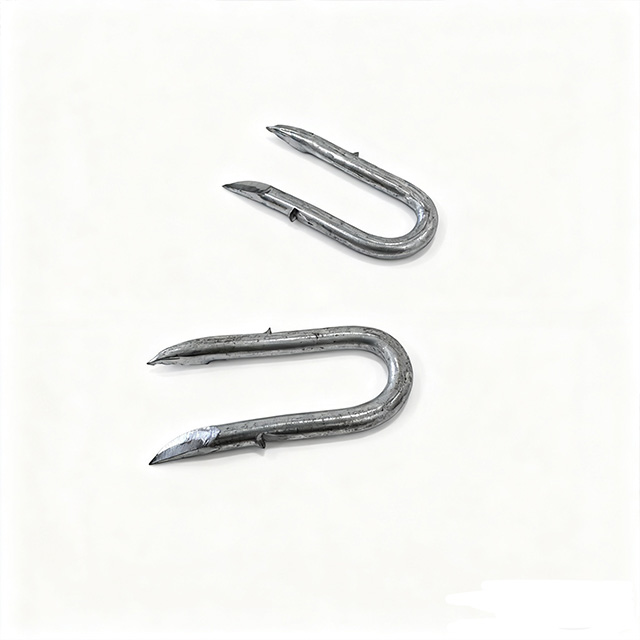
Application Range: U-shaped nails are engineered to secure flexible materials (mesh, wire, fabric) to solid wood substrates without tearing or shearing the material.
Performance Differentiator: For high-stress applications (e.g., livestock fencing), U type iron nails with barbed shank offer exponentially higher pull-out resistance than smooth-shank alternatives.
Cost Efficiency (TCO): Matching the correct gauge, length, and galvanization standard (e.g., ASTM A153) prevents premature rust failures and reduces long-term replacement costs.
Installation Compatibility: Proper specification allows for integration with pneumatic staplers, drastically reducing manual labor costs on large-scale projects.
You must understand the fundamental physics of fastening to appreciate U-nails. Standard straight nails act like wedges. They concentrate driving force into a single entry point. This often splits wood and tears delicate materials. U-nails take a completely different mechanical approach.
The "Crown and Leg" Anatomy
Standard nail heads easily punch through soft materials under pressure. U-nails prevent this. The broad crown provides continuous surface contact. It pins the material down rather than piercing it. For projects requiring even more security, using U Type Iron Nails with Barbed Shank adds a layer of mechanical locking that standard smooth legs cannot provide. This load distribution prevents delicate agricultural mesh, vapor barriers, or upholstery fabrics from tearing out when placed under tension.
Preventing Wood Splitting
Driving thick, single-shaft nails near the edge of a wooden board often causes splitting. The single shaft forces the wood grain apart aggressively. U-nails disperse this stress across two narrower points. They minimize the risk of splitting at structural edges. This makes them highly reliable for precision carpentry and thin wood applications.
Load Distribution
Standard nail heads easily punch through soft materials under pressure. U-nails prevent this. The broad crown provides continuous surface contact. It pins the material down rather than piercing it. This load distribution prevents delicate agricultural mesh, vapor barriers, or upholstery fabrics from tearing out when placed under tension.
Different industries leverage the U-nail design to solve specific material holding challenges. Let us examine the four main application sectors.
Fencing remains the most common use case. Farmers and agricultural contractors use these fasteners to secure high-tensile wire, barbed wire, and poultry mesh to heavy wooden posts. Agricultural environments demand high resistance to dynamic impact. Livestock frequently lean against or bump into fences. To counteract these forces, professionals often specify U Type Iron Nails with Barbed Shank to ensure the wire stays pinned. The fastener must hold securely without bending or backing out under sudden animal impacts.
Builders rely on U-shaped fasteners for structural integrity and aesthetics. They fasten plywood, particleboard, and moisture vapor barriers. The crowned design holds these panels securely. Carpenters also use them where they desire hidden nail heads. The dual-leg design allows for a flush finish. This meets strict aesthetic requirements in interior finishing work.
Logistics companies face massive risks during transit. They use large U-nails to reinforce the edges of wooden pallets. They also secure heavy-duty corrugated cartons to wooden bases. The broad crown holds strapping bands and thick cardboard firmly. This prevents burst failures when crates shift violently during overseas shipping.
Furniture makers deal with delicate, expensive textiles. They must fix fabrics and leathers securely to hard wooden frames. Standard nails would puncture or tear these soft textiles. Small-gauge U-nails hold the fabric gently but firmly. They leave minimal marks and ensure the material does not fray over years of daily use.
Not all U-nails perform equally. The texture of the nail legs—known as the shank profile—dictates the fastener's holding power.
The Business Problem
Smooth shank U-nails are cheap and very easy to drive into hard wood. However, they carry a hidden flaw. Wood expands and contracts as ambient moisture levels change. Furthermore, fences face repetitive vibration from wind and physical impacts. Over time, these forces cause smooth shanks to slowly back out of the wood. This loosening leads to total fence failure.
The Barbed Solution
To solve this costly problem, engineers developed U Type Iron Nails with Barbed Shank. The shanks feature tiny, angled cuts that act as one-way mechanical grips. As the nail enters the wood, the barbs slice through the grain. If tension pulls the nail upward, the barbs bite firmly into the surrounding wood fibers. This creates massive pull-out resistance.
Single Barbed: These feature one row of barbs per leg. They offer moderate grip improvement over smooth shanks. They work well for medium-duty garden fences.
Double Barbed: These feature barbs on both sides of each leg. They act as permanent anchors. They effectively double the withdrawal resistance. You need this extreme grip for heavy-duty livestock fencing.
Point Design (The "Duckbill")
Look closely at the tip of a high-quality U-nail. You will rarely see a standard round point. Instead, you will see a "duckbill point" or a slice-cut sharp point. This flat, angled cut allows the legs to splay or twist slightly upon entry. This internal twisting locks the nail securely into the substrate. It ensures accurate, clean penetration. This reduces installation misfires and limits wasted hardware.
Implementation Risk and Best Practices
You must exercise caution. Barbed shanks provide permanent holding power. They are nearly impossible to remove without severely damaging the underlying wood. You must specify them only for permanent installations. If you anticipate moving or adjusting the fence line later, use smooth shanks instead.
Buying fasteners in bulk requires exact specifications. You must align your required duty level with the correct inch, gauge, and millimeter measurements.
Navigating different measurement systems can confuse buyers. Use this shortlisting framework for procurement to ensure you order the correct dimensions.
Duty Level | Standard Inch Size | Wire Gauge | Length (mm) | Diameter (mm) | Ideal Application |
|---|---|---|---|---|---|
Light Duty | 3/4" | 16 Gauge | ~19.1 mm | 1.65 mm | Upholstery, poultry mesh, vapor barriers |
Standard Duty | 1" | 14 Gauge | ~25.4 mm | 2.10 mm | Field fencing, residential carpentry |
Heavy Duty | 1-1/2" to 2" | 9 to 11 Gauge | 38 mm - 50 mm | 3.0 mm - 3.7 mm | High-tensile cattle fencing, pallets |
Extreme Duty | 2-1/2" to 3" | 8 Gauge | 60 mm - 76 mm | 4.0 mm+ | Thick agricultural posts, heavy packaging |
Selecting the right metal grade determines how long your project will last. Most U-nails use Q195 or Q235 carbon steel. The core difference lies in the surface treatment.
Electro-galvanized vs. Hot-Dipped
Electro-galvanized nails feature a very thin layer of zinc. They look shiny and cost less. However, they rust quickly outdoors. For outdoor or agricultural exposure, you must specify hot-dipped galvanized coatings. These nails undergo a molten zinc bath. This creates a thick, durable barrier. Ensure your supplier meets internationally recognized standards like ISO 1461 or ASTM A153/A641.
The Ultimate Trade-off
Stainless steel U-nails offer the ultimate corrosion resistance. They survive coastal salt spray and highly acidic soils. However, they carry a massive cost premium. For 90% of commercial projects, heavily galvanized carbon steel (Q195/Q235) offers the best return on investment (ROI). It balances longevity with procurement budget constraints.
Savvy procurement teams look beyond the initial unit price. They evaluate the total cost of ownership (TCO) to optimize their budgets.
Labor Savings via Pneumatic Compatibility
Loose U-nails cost less per unit. Workers hammer them manually. This method is slow and physically exhausting. Conversely, collated U-shaped brad nails fit seamlessly into pneumatic stapling guns. While the hardware costs slightly more, pneumatic installation slashes labor time by up to 70%. On large-scale agricultural or construction projects, this labor reduction vastly outweighs the higher hardware cost.
Pricing Drivers for Bulk Orders
Several factors dictate your final invoice price. We have summarized the main cost drivers in the chart below.
Cost Driver | Market Impact | Procurement Note |
|---|---|---|
Material Grade | High | Stainless steel costs significantly more than carbon steel. |
Zinc Coating Thickness | Medium | Hot-dipped galvanization (thick) costs more than electro-galvanization (thin). |
Shank Profile | Low to Medium | Barbed shanks require extra machining, adding slight costs over smooth shanks. |
Custom Sizing | High | Standard sizes ship immediately. Custom lengths require factory tooling fees. |
You must also evaluate freight efficiency. Establish baseline expectations for standard export packaging. Most reputable factories pack these fasteners in 20 to 25 kg cartons or bags. Standardized packaging maximizes shipping container volume. It protects the hardware from moisture during long ocean transits.
Quality Control Verifications
Never buy blind. Advise your quality control team to request manufacturer documentation before finalizing bulk orders. Ask for tensile strength testing reports. Request certificates proving surface treatment uniformity. Check for compliance with DIN 1151 or similar manufacturing standards. These documents prove you are dealing with a reputable factory. They prevent you from receiving brittle batches or nails that rust after the first rainstorm.
The success of any fastening application depends entirely on marrying the correct size, material, and shank type to the substrate. You cannot rely on guesswork. Selecting the right hardware protects your structural integrity and safeguards your maintenance budget.
Follow a simple shortlisting logic. For delicate, indoor, or temporary jobs, smooth shanks suffice. However, for maximum longevity in outdoor, high-stress environments, U Type Iron Nails with Barbed Shank stand as the definitive choice. They provide the unrelenting grip required for heavy-duty fencing and packaging.
Take action today. Audit your current project's tension requirements. Review our sizing matrix to pinpoint your ideal gauge and length. Finally, contact your supplier to request sample testing or detailed technical specification sheets before you place your next bulk order.
A: Industry professionals use several terms interchangeably. You might hear them called fencing staples, netting clips, poultry staples, or U-pegs. The terminology generally depends on the specific region or the intended industrial application.
A: Yes. You can purchase loose U-nails for manual hammering. However, manufacturers also produce collated U-shaped brad nails. These collated strips fit directly into pneumatic staplers, which drastically reduces manual labor time on large-scale jobs.
A: Follow a basic industry rule of thumb. The substrate wood material must be thick enough to accommodate at least two-thirds of the nail's leg length. This ensures optimal mechanical grip without the sharp points punching out the back.
A: A duckbill point is a specialized flat, angled cut at the tip of the legs. When you drive the nail, this unique shape forces the legs to twist slightly inside the wood grain. This twisting increases overall holding friction.


