
Views: 0 Author: Site Editor Publish Time: 2026-05-12 Origin: Site


Yes, manufacturers specifically design stainless steel roofing nails for environments where standard galvanized fasteners will fail prematurely. You might wonder if such an upgrade is truly necessary for your next construction project. Often, builders completely overlook the fastener selection until a catastrophic and premature roof failure occurs.
If you are asking this question, you likely face coastal environments, high-end roofing materials like slate, or highly corrosive climates. In these harsh conditions, standard roofing nails rust out long before the actual roof reaches the end of its intended lifespan. Fastener degradation heavily compromises structural integrity, causing loose shingles, wind uplift, and expensive water intrusion.
This guide provides a detailed technical breakdown of stainless steel grades, shank profiles, and installation tool compatibility. We will help contractors and homeowners select the exact fastener required for long-term structural stability. You will learn how to match fastener lifespans to premium materials and permanently eliminate the risk of early roof failure.
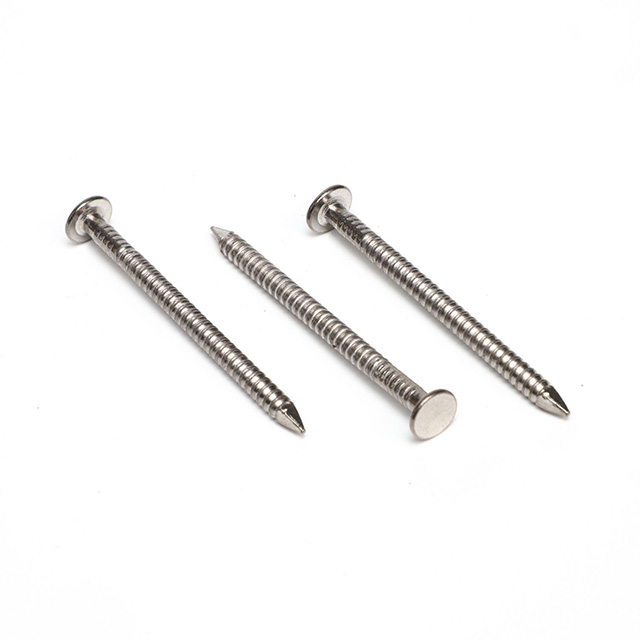
Stainless steel roofing nails eliminate the risk of fastener-induced roof failure and rust bleed in harsh environments.
Matching the lifespan of the nail to the roofing material (e.g., slate, architectural asphalt) is a critical ROI driver.
Selecting between 304 and 316 grades depends entirely on proximity to saltwater or chemical exposure.
Ring shank profiles provide necessary pull-out resistance for high-wind zones, while coil configurations ensure pneumatic tool compatibility.
Upfront material costs are higher, but the Total Cost of Ownership (TCO) is significantly lower when factoring in avoided roof repairs.
Roofing professionals constantly battle the elements. The most significant business problem contractors face involves fastener degradation. Standard galvanized nails rely on a superficial zinc coating to prevent rust. Even hot-dipped galvanized variants have vulnerabilities. When a pneumatic nail gun driver strikes the nail head, it often micro-fractures this protective zinc layer. Small scratches occur naturally during installation. Over time, moisture exploits these compromised areas, leading to rapid oxidation, rusted nail shanks, and inevitable water intrusion.
Structural integrity depends entirely on the hidden fasteners holding the system together. Once a nail begins to rust, it loses its structural holding power. The shaft thins out and becomes brittle. Wind events then easily lift the shingles. We see localized roof failures happening decades before the actual shingle or underlayment degrades. The entire roof assembly is only as strong as its weakest component.
Beyond structural failure, property owners face severe aesthetic risks. Rusted fasteners bleed. Brown rust streaks slowly drip down expensive roofing materials. This staining permanently ruins the look of premium architectural shingles. It also discolors white painted fascia boards and exterior trim below the roofline. Homeowners despise these visible rust stains, often demanding expensive cosmetic repairs.
We must evaluate fasteners through a Total Cost of Ownership (TCO) lens. The upfront cost difference between galvanized nails and Stainless Steel Roofing Nails seems steep initially. However, this premium is negligible compared to the massive labor and material costs required to replace a failing roof. Premature roof replacements drain budgets. Upgrading your fasteners acts as a cheap insurance policy for the entire building envelope.
Fastener Type | Initial Cost | Corrosion Resistance | Expected Lifespan | Long-Term TCO |
|---|---|---|---|---|
Electro-Galvanized | Low | Poor (Scratches easily) | 10-15 Years | Extremely High (Requires early roof replacement) |
Hot-Dipped Galvanized | Medium | Moderate | 15-30 Years | Moderate (Fails in coastal zones) |
304/316 Stainless Steel | High | Excellent (Solid material, no coating) | 50-100+ Years | Very Low (Outlasts the roofing material) |
Architects and engineers employ a core principle known as the Lifespan Matching Framework. This standard dictates a simple rule. You must never use a 20-year fastener on a 50-year or 100-year roofing material. Failing to follow this framework guarantees premature system failure.
Assess the Material Lifespan: Determine the manufacturer's expected lifespan for the primary roofing cover.
Determine Environmental Load: Evaluate local weather, wind codes, and proximity to corrosive bodies of water.
Select the Fastener: Choose a nail material guaranteeing equal or greater longevity than the roof covering.
High-end, legacy materials absolutely require stainless steel fasteners. Consider a slate roof. Natural slate tiles can easily last 75 to 150 years. Standard galvanized nails will disintegrate decades before the slate itself fails. When the nails rust away, heavy slate tiles simply slide off the roof deck. This creates massive safety hazards and catastrophic leaks. You must match the permanence of slate to the permanence of solid stainless steel.
Standard asphalt and architectural shingles typically utilize galvanized nails. However, you should upgrade to high-quality Stainless Steel Roofing Nails under specific geographic conditions. Properties located near saltwater coastlines demand this upgrade. Salt spray travels miles inland, deteriorating galvanized steel rapidly. High-humidity regional weather also accelerates oxidation. Upgrading protects the asphalt roof warranty in these punishing environments.
Specialty materials introduce chemical complexities. Cedar shakes contain naturally occurring tannins. Tannic acid reacts violently against galvanized steel. This reaction creates deep black stains on the wood and rapidly destroys the nail shank. Copper flashing introduces galvanic corrosion risks. If a standard steel nail touches copper under wet conditions, the steel sacrifices itself and rusts away. Stainless steel remains entirely inert, preventing these destructive chemical and galvanic reactions.
Fastener geometry matters just as much as material composition. The shank profile determines how well the nail grips the roof decking underneath the shingle. Builders primarily choose between two distinct shank styles based on local wind threats and material requirements.
Smooth Shank: These nails feature a completely smooth wire shaft. They are easier to drive into dense materials. However, they offer significantly lower holding power. Over time, wood decking expands and contracts during temperature shifts. This movement slowly pushes smooth shank nails upward, a phenomenon known as "nail pop."
Ring Shank: These fasteners feature distinct threaded rings along the shaft. As the nail enters the wood decking, wood fibers settle into these grooves. The rings lock the nail into place securely. Ring shank profiles dramatically increase pull-out resistance. This specific profile is absolutely essential for hurricane zones and high-wind environments where uplift forces destroy weak roofs.
Installation methods directly dictate your purchasing format. Hand-driven applications require bulk or loose nails. Suppliers sell these by the pound, packaging them in one-pound boxes or large bulk buckets. Hand-nailing works best for precise, manual installation on delicate materials like slate or custom flashing work. It allows the installer to control the strike force perfectly, preventing material cracking.
Modern commercial roofing relies on pneumatic speed. For rapid deployment, contractors use collated coil nails. Manufacturers weld these nails to two thin wires or collate them using a plastic band. The installer loads the coil into a pneumatic roofing nail gun, allowing them to fire hundreds of fasteners in minutes.
Tool compatibility risks can derail a project immediately. You must verify the coil degree angle before purchasing. Most commercial roofing nailers require a 15-degree wire-welded coil. Additionally, verify the wire gauge thickness. Feeding the wrong coil angle or gauge into a nail gun causes continuous jamming, severe tool damage, and costly job site downtime. Always cross-reference the nail gun manufacturer's specifications.
Metallurgy defines the exact corrosion resistance of the fastener. Buyers typically face a choice between two distinct stainless steel alloys when selecting their Stainless Steel Roofing Nails. Making the incorrect choice here leads to unexpected corrosion, even when using premium metal. Let us define the exact boundaries for each grade to ensure your procurement strategy aligns with the project's environmental demands.
Type 304 represents the standard commercial grade for stainless steel. It contains high levels of chromium and nickel, providing excellent general corrosion resistance. It performs exceptionally well in inland areas facing high moisture. It easily resists acid rain exposure. For standard high-end material installations located away from the ocean, 304 offers perfect protection at a reasonable price point.
Type 316 represents the true marine grade alloy. Metallurgists add a crucial element called molybdenum to this specific alloy. Molybdenum drastically enhances the metal's resistance to chloride pitting. Saltwater vapor settles on roofs, carrying highly corrosive chlorides. Without molybdenum, salt particles will slowly pit and destroy 304 stainless over time. Therefore, 316 is a non-negotiable requirement for properties located within five to ten miles of a coast.
Local building codes often enforce these choices strictly. Coastal building authorities routinely mandate 316 grade fasteners for any exterior building envelope application. Inspectors will reject projects utilizing incorrect alloys. Ensuring strict compliance prevents failed inspections and expensive rework.
Environmental Condition | Distance from Coast | Recommended Grade | Reasoning |
|---|---|---|---|
Inland / High Humidity | 50+ Miles | 304 Stainless | Provides standard rust protection. Molybdenum is unnecessary. |
Industrial / Acid Rain | Inland Cities | 304 Stainless | Resists standard atmospheric pollutants effectively. |
Coastal / Salt Spray | Within 5-10 Miles | 316 Stainless | Molybdenum prevents severe chloride pitting and rapid decay. |
Direct Beachfront | 0-1 Mile | 316 Stainless | Mandatory. Extreme continuous salt exposure requires maximum defense. |
Contractors must estimate project needs accurately to control costs. Stainless steel carries a premium price per pound. You calculate required poundage based on the total square footage of the roof and the specific shingle exposure. Standard architectural shingles typically require four nails per shingle in normal zones, and six nails per shingle in high-wind zones. A standard 30-square roof (3,000 square feet) might require roughly 60 to 75 pounds of bulk nails, or specific coil counts depending on the manufacturer's packaging.
Manufacturers offer diverse packaging options to support project scalability. Retail packs come in small one-pound to five-pound plastic tubs. These small units work perfectly for minor residential repairs, custom fascia work, or replacing a few slipped slates. You avoid paying for material you do not need.
Full-scale commercial or residential installations demand bulk procurement. Distributors ship bulk Stainless Steel Roofing Nails in large 25-pound or 50-pound boxes. Coil nails usually arrive in boxes containing 3,600 to 7,200 individual nails. Buying in large volumes drastically reduces the cost per fastener.
Navigating the supply chain requires planning. You will rarely find specialized fasteners, like 316 marine-grade ring shank coil nails, sitting on the shelf at a standard big-box retail store. Retailers cater to basic DIY projects, stocking cheap galvanized options. Professional-grade stainless fasteners often require direct B2B supplier orders. You must engage specialty fastener distributors well in advance of your project start date to secure inventory.
Upgrading to premium fasteners serves as the smartest, most inexpensive insurance policy you can buy for an overall roof assembly. The hidden hardware ultimately dictates the survival of the entire structure during extreme weather events. By choosing the right metal alloy, you guarantee your roof deck remains watertight for decades.
Evaluate your precise geographic location first. Coastal zones unconditionally require marine-grade 316 alloys to survive airborne chlorides.
Analyze your roofing material choice. Legacy materials like slate and cedar demand stainless steel to prevent early fastener failure and chemical staining.
Identify your installation method early. Match collated coil specifications precisely to your pneumatic tools to prevent job site delays.
Take action by reviewing bulk pricing tiers through specialized B2B suppliers, and request a customized quote tailored to your specific architectural plans.
A: Yes. While standard galvanized nails are typical for asphalt, stainless is highly recommended for coastal asphalt roofs to prevent rust and wind-uplift failures. They provide unmatched long-term holding power, ensuring the asphalt shingles do not blow off during major storm events.
A: If you are within 5-10 miles of the ocean or subject to heavy industrial salt/chemical exposure, 316 is required to prevent chloride pitting. Otherwise, 304 is sufficient. The 304 grade handles inland humidity perfectly, while 316 contains molybdenum specifically added to fight aggressive marine salt.
A: Yes, provided you purchase them in collated "coil" format and match the collation angle (usually 15 degrees) to your specific nail gun model. You must also ensure the wire gauge falls within the acceptable range listed in your tool's manual to avoid continuous jamming.
A: A slate roof can last 75 to 150 years. Standard nails will rust away in a fraction of that time, causing the heavy slate tiles to slip off the roof. The fastener must match the longevity of the material. Stainless steel provides the permanent structural support slate tiles require.


